Logo with three blue vertical bars on the left and the text "ACC Capital Empowering Entrepreneurs" in white on a light gray background.
What We Do

What We Do

We're a mission-driven lender and resource partner delivering accessible capital nationwide. From small business loans to large-scale project finance, we help bring visions to life.

Explore Our Services

Small Business Lending

SBA 7(a) Loans

Flexible funding for working capital, equipment, real estate, start-up costs, debt refinance, inventory or expansion

SBA 504 Loans

Fixed-rate financing for real estate or major assets

Microloan Program

Small, flexible loans loans to kickstart or grow your business

View all Small Business Lending Services →

Project Finance

New Market Tax Credits

Financing for projects that drive community development

EB-5 Investment Program

Lower-cost capital for rural manufacturing and industrial projects.

View all Project Finance Services →

Entrepreneurial Education

ACC Capital Foundation

Programs and mentorship for aspiring entrepreneurs

EDGE Summit

Showcase student business ideas and network

YES Competition

Entrepreneurship challenges for younger students

Governor’s Cup

Collegiate business plan and pitch competition

Not sure which program is right for you?

We’ll help match you with the best option.

Contact Our Team
Our ImpactAbout UsContact Our Team
Search
Close
Apply for a loan
Search
Logo with three blue vertical bars on the left and the text "ACC Capital Empowering Entrepreneurs" in white on a light gray background.
  • Home
  • What We Do
    • Small Business Lending
      • SBA 7(a) Loan
      • SBA 504 Loans
      • Microlending (Arkansas Only)
    • Investment & Project Finance
      • New Market Tax Credits
  • Our Impact
  • About Us
  • Contact Our Team
  • Honors & Awards
  • Blog
  • Careers
  • Get In Touch
  • Language Assistance Plan
Apply for a loan
Menu

25th Annual ACC Capital Governor’s Cup Celebrates Southern Student Entrepreneurs, Awards Over $140,000 in Prizes

अप्रैल 28, 2025 by Isabella

LITTLE ROCK, ARK. – Undergraduate and graduate students from colleges and universities across the Southern United States gathered last week for the 25th annual ACC Capital Governor’s Cup Collegiate Business Plan Competition, one of the region’s premier collegiate entrepreneurship competitions. Powered by Title Sponsor Dhu Thompson and Supporting Sponsor the Walton Family Foundation, the Governor’s Cup challenges students to solve real-world problems through entrepreneurial business plan development and present their ventures to a panel of industry expert judges, competing for top honors across three divisions and a share of more than $140,000 in cash prizes.

This year’s first-place winners are:

● Small Business Division: Retra, Ouachita Baptist University (Arkadelphia, AR)

● High Growth/Technology Division – Undergraduate: TheraLink, Harding University (Searcy, AR)

● High Growth/Technology Division – Graduate: Image Devices, Inc., University of Texas at Austin (Austin, TX)

Participation in the 2025 competition surged, with applications increasing by 170% compared to 2023. The final round included student teams from four states, reflecting the growing regional impact and expansion of ACC Capital’s entrepreneurship initiatives.

More than 600 attendees gathered for the awards luncheon, which featured a fireside chat with John and Miles Stephens, the new co-CEOs of Stephens, moderated by ACC Capital CEO Sam Walls III. Their conversation highlighted the generational impact of entrepreneurship and discussed how capitalism continues to shape the economy and drive innovation across communities.

“As we celebrate the 25th anniversary of the ACC Capital Governor’s Cup Collegiate Business Plan Competition, we are proud to recognize its continued growth and impact,” said Walls. “The expansion of the competition to neighboring states reflects ACC Capital’s broader strategy to extend our products and services beyond Arkansas to support entrepreneurs across the nation. We congratulate all participating teams and are excited to support the next generation of innovators. As we look ahead, we are committed to building on this momentum and shaping the future of entrepreneurship for the next 25 years and beyond.”

Since its founding in 2001, the Governor’s Cup has impacted more than 3,250 students, awarded over $2.9 million in cash prizes, and helped catalyze business ventures, product

commercialization, and entrepreneurial leadership throughout Arkansas and the broader region. As part of ACC Capital’s larger EDGE Initiative (Education to Develop and Grow Entrepreneurs), the Governor’s Cup remains a cornerstone program dedicated to empowering students through education, competition, mentorship, and real-world experience — preparing the next generation of innovators and business leaders for lasting success. For more information about the Arkansas Governor’s Cup, visit https://acccapital.com/.

—————————————

About ACC Capital

ACC Capital is a private, nonprofit lending corporation empowering entrepreneurs nationally. The organization offers flexible capital solutions to meet the unique needs of entrepreneurs, small businesses, and economic and community development projects. Since 1957, ACC Capital has partnered with commercial banks, government agencies, and others at local, state, regional, and national levels to deploy over $2.34 billion in capital financing. Learn more about us on our website at https://acccapital.com and follow us on Facebook and Instagram at @ACCcapitalcorp. You can also connect with us on LinkedIn. Se Habla Espanol.

Filed Under: Arkansas Capital Corporation Group News, Article, Entrepreneurship Foundation News Tagged With: arkansas entrepreneurship, arkansas small business, Governor's Cup

ARKANSAS CAPITAL CORPORATION IS NOW ACC CAPITAL

अप्रैल 8, 2025 by Isabella

LITTLE ROCK, ARK. (April 14, 2025) — Arkansas Capital Corporation (ACC) is changing its name to ACC Capital, effective April 14, 2025. The new name reflects the growth of the organization’s client base and product and service offerings to small businesses nationwide.

“Our new company name signifies a need for change to reflect our national lending footprint, while giving a nod to our extensive history in Arkansas” said Sam Walls III, Chief Executive Officer. “Our Board of Directors and corporate team are excited about the opportunities that will come from our new name that symbolizes the organization’s future direction.”

ACC gained its reputation in the late 1950s as a provider of flexible capital solutions to meet the unique needs of entrepreneurs, small businesses, and economic and community development in Arkansas. In 2023, the nonprofit CDFI was one of three organizations to receive a Small Business Lending Company (SBLC) license from the U.S. Small Business Administration (SBA), the first license awarded in nearly forty years.

With the SBLC license, ACC Capital initially launched its small business lending products and services in the southeastern United States. The organization’s name now speaks to its vision of expanding its support to entrepreneurs nationally.

###

About ACC Capital

ACC Capital is a private, nonprofit lending corporation empowering entrepreneurs nationally. The organization offers flexible capital solutions to meet the unique needs of entrepreneurs, small businesses, and economic and community development projects. Since 1957, ACC Capital has partnered with commercial banks, government agencies, and others at local, state, regional, and national levels to deploy over $2.34 billion in capital financing. Learn more about us on our website at https://arcapital.com and follow us on Facebook and Instagram at @arcapitalcorp. You can also connect with us on LinkedIn. Se Habla Espanol.

Filed Under: Article

Why New Market Tax Credits from Our CEO, Sam Walls

अक्टूबर 25, 2022 by Isabella

Did you know that Arkansas Capital Corporation Group has leveraged almost $400 million dollars in federal New Market Tax Credits for development in distressed communities? Read more about what our CEO Sam Walls calls “one of the most efficient community economic development tools for low-income communities ever enacted” from the Arkansas Democrat-Gazette.

Filed Under: Article

Entrepreneur Loans: The Lending Assistance Options Available to You

सितम्बर 30, 2022 by Isabella

Entrepreneurs who work with Arkansas Capital Corporation (ACC) know that we listen. We’re not trying to check boxes. We’re not trying to meet quotas. We’re listening to our entrepreneurs and coming up with solutions that best fit their needs, not ours. If they have a specific dream business they’ve spent a lot of time working towards, we help them realize that dream.

We partner with federal government organizations such as the USDA and SBA, as well as community banks throughout Arkansas and surrounding states. We also do commercial conventional lending. Therefore, we can tailor a solution for many businesses and it’s likely we can present a funding package not previously considered.

Often, when entrepreneurs and small business owners approach a lender for funding, they don’t know what questions to ask. They have a vision for the business but haven’t done the due diligence to determine what is needed financially to help make their dreams come true.

So, to understand what money you need, spend time learning about your target business market. An excellent place to start is by talking to others who are already in that industry. There are also several organizations that can help. For example, the Arkansas Small Business and Technology Development Center (ASBTDC) is a terrific statewide resource, and is supported by the SBA. The ASBTDC and other resource providers can help you with important homework, such as creating financial projections and providing important marketing and validation research for your plan. Then, you’ll be ready to get in touch with ACC to find out about lending opportunities.

We especially enjoy working to help community banks and their local entrepreneurs and small business owners who may not meet their bank’s required criteria for lending. Therefore, they are unable to make the loan – and that’s when many of them turn to ACC to see if a financing package is available. In many cases, we are able to extend credit and take on added risk to make the loan happen.

This is a win-win for the entrepreneurs and small business owners, community banks, and for ACC. Businesses can be launched and grown, resulting in yet another win – for local and regional communities and their economic development efforts.

Everything we do at ACC is in support of Arkansas businesses. We have several different financing programs that we utilize, depending on what the individual entrepreneurs are seeking. We have funds for them to start, buy, or expand businesses; buy or improve commercial real estate; buy into a franchise; and/or refinance commercial debt.

We’re looking to create opportunities, not just for the entrepreneurs and business owners, but for the people they employ. ACC is proud to have worked with them and with our lending partners to make loans totaling nearly $700 million over the past 65 years. Their success is our success!

Filed Under: Article Tagged With: SBA loans

Arkansas Capital Corporation’s Commitment to Community Engagement and Development

सितम्बर 2, 2021 by Isabella

America and Arkansas were built on the foundation of dreams—the dreams to own a thriving business; to purchase a home you’re proud of; to access quality education; to adequately provide for your family, and to live a vibrant wholesome life.

In many instances, dreams have been extinguished due to a lack of financial accessibility. At Arkansas Capital, one of our main goals is to create accessibility so that our Natural State neighbors can realize their dreams. Community engagement and targeted outreach make this vision for a better life a true possibility.

Community Development in Arkansas

Community development in Arkansas is essential as it supports improvements in the quality of life for low-and moderate-income individuals and rural communities. In 2020, the United States Census reported that more than 16 percent of Arkansas residents are living in poverty. The per capita reported income in 2019 was just over $26,000. This illustrates the dire need for community support and engagement. At Arkansas Capital, we strive to formulate and offer traditional and creative solutions that will stimulate economic growth through lending products, tax credits, and other funding mechanisms, and entrepreneurial training and development thereby creating stronger communities throughout the state.

Why Is Community Development in Arkansas So Important?

Community development advances our communities by increasing homeownership rates, spurring small business development, increasing graduation rates, supporting workforce development, and more. Community development ensures that Arkansas residents have vital living components to live more sustained and healthier lives. Investing in our neighbors allows us to build a foundation, which enables our neighborhoods to attract and keep talent, start and build businesses, and resolve problems that arise.

When community development works, it results in less crime, shrinks wealth gaps, creates more and better jobs, nurtures a more capable and willing workforce, and decreases overall problems that directly impact residents. Some examples of community development include:

  • Helping an aspiring grocery store owner open a store in a food desert (a geographical area without access to grocery stores within a walkable distance); and,
  • Helping property developers purchase and renovate dilapidated homes in poverty-stricken areas to decrease crime and increase overall property values in the area.

Building Arkansas Up

By promoting entrepreneurship, supporting small businesses, and striving to make commercial financing accessible, we can increase prosperity in Arkansas. One way we do this is by offering an array of lending products to build Arkansas up.

Lending Services

We offer loans to help our Arkansas neighbors

  • create startups,
  • acquire and expand existing businesses,
  • build or expand commercial real estate,
  • obtain working capital,
  • purchase commercial equipment, and
  • facilitate rehabilitation of properties.

To service a variety of borrowers, we offer the following types of loans:

  • SBA 504
  • USDA B & I
  • Conventional commercial loans
  • SBA7(A)
  • Express

To ensure you are best positioned for long-term success, we offer:

  • military loan advantages,
  • competitive interest rates,
  • lower down payments, and
  • reasonable collateral requirements.

In addition to our lending services, Arkansas Capital impacts community development through its Heartland Renaissance Fund (HRF). HRF is a subsidiary of Arkansas Capital and a Community Development Entity (CDE) as certified by the U.S. Department of Treasury.

This CDE designation allows Arkansas Capital to facilitate community development financing and job creation opportunities targeted to low-income communities in Arkansas and surrounding states, most notably through the deployment of New Markets Tax Credits (NMTCs).

Arkansas Capital was the first CDE established in the state when it launched HRF in 2001. Since that time, through multiple rounds of allocations, Arkansas Capital has deployed $355 million of NMTCs into Arkansas and surrounding states.

With a combined $1.1 billion in transaction experience and over 75 years of experience in structuring investment capital, Arkansas Capital’s HRF team can help innovative, early-stage, and high-growth companies in the following areas:

  • tax credit syndication / tax credit finance,
  • developing public/private partnership opportunities, and
  • alternative financing solutions.

Community Development the Arkansas Capital Way

“Our first question is not ‘how can we make money?’ Our first question is ‘where is there a need?’ Over the years, these things you’ve seen us do have been a response to specific needs—no one else is doing it, so we say, ‘Alright. Let’s do it.’’’

Sam Walls, III – President and COO, Arkansas Capital Corporation

We’d like to talk to you more about your ideas – call us, or fill out our online form to let us know how we can help.

Filed Under: Article

New Market Tax Credit vs. Opportunity Zone: Pros and Cons

अगस्त 17, 2021 by Isabella

Empty warehouses with cracked windows, outdated manufacturing facilities, and desolate commercial spaces: this scene is all too common in many impoverished areas in the United States. Thankfully, two federal tax incentive programs exist that are designed to improve such places by promoting private capital investment in distressed areas across the country. These two programs are the New Market Tax Credit (NMTC) Program and the Qualified Opportunity Zone (OZ) Program.

The goals of the programs are similar, working to improve economic situations in historically low-income areas. However, there are key differences when it comes to comparing the new market tax credit vs. opportunity zone programs. In this article, we’ll discuss the pros and cons of each incentive.

Pros of the New Market Tax Credit

The New Market Tax Credit incentive has generated $8 of private investment for every $1 of federal funding provided. It’s funded over 5,400 businesses and has developed 178 million square feet of manufacturing, office, and retail space. Since its beginnings in 2000, $27 billion in tax credits has been allocated to investors, halting disinvestment in communities that need economic support most. This is to say that there are many benefits happening across the nation as a result of the NMTC Program.

In addition to the obvious positive impact on communities across the nation, investors also benefit by applying the tax credit to their annual federal income taxes. The incentive allows investors a direct tax credit for seven years following an investment within a struggling community that culminates in a total tax credit on the amount invested of 39%. Investors can claim 5% of the specified investment amount every year for the initial three years. Then, they can claim 6% for each of the last four years, adding up to the seven-year 36% total tax credit.

Stipulations of the New Market Tax Credit

There are a few stipulations for the NMTC, which some investors may see as cons. Many first ask what can new market tax credits can be used for, and one potential con of the NMTC Program is that it can only be applied as a tax credit against the investors’ annual federal tax returns. It can be used in no other way.

Additionally, to qualify for the tax credits, the investment project must be designated as NMTC-eligible within a qualified census tract. The more economically distressed an area, the more likely the Community Development Entity (CDE) is to be approved to receive tax credits. Historically, the CDFI has preferred CDEs to invest in communities where poverty rates exceed 30% and the median incomes of the area are no more than 60% of the statewide median income.

Investors are required to go through a CDE to receive tax credits. All NMTC applicants must be certified as CDEs, then distribute the approved credits to the investors, meaning that a business or investor cannot directly apply for the tax credit.

Lastly, the NMTC is up for renewal yearly. This means Congress could decide to end the program. However, this is not expected in the future, as the incentive has been renewed a number of times since its inception in 2000 and has a proven track record of revitalizing low-income areas. Congress not only voted to continue the incentive in 2021, but they also increased funding for it. For many, the pros of the NMTC Program outweigh the potential cons.

Application Process for the New Market Tax Credit

The process of applying for the NMTC may vary depending on qualification and location, however, generally, it only takes five steps:

  1. A Community Development Entity (CDE) must be established.
  2. The CDE submits an NMTC Allocation Application.
  3. Once the application is approved, the CDE will get the tax credit allocations to provide to the investors.
  4. The CDE will distribute the tax allocations to private investors.
  5. The private investors will put their money up according to their tax credit allocation.

Note that there are timelines regarding this application, so be sure to see the CDFI website, and reach out to us with any questions (click for state-specific information).

Differences Between the New Market Tax Credit vs. Opportunity Zone Programs

The primary difference between the new market tax credit vs. opportunity zone programs is that Congress must decide annually to renew the NMTC incentive, and it’s approved by the Treasury Department and the CDFI staff. The OZ program is a part of an International Revenue Service (IRS) rule; as such, it doesn’t have to be approved every year. Additionally, Arkansas Opportunity Zones affect capital gains on an investment, as opposed to being applied as a direct tax credit on a federal return (as the NMTC is).

Pros of the Opportunity Zone Program

In 2017, the US government developed the OZ Program to promote investments in economically disadvantaged areas. It also gave investors wondering how to invest in opportunity zones an additional avenue for wealth-building. There are 8,700 areas in the US that are designated Opportunity Zones, offering investors a number of communities to support while they generate passive income. Additionally, some Opportunity Zone tax benefits stand right now, including the following:

  • Previously earned capital gains can be temporarily deferred by placing these assets in Opportunity Funds (an investment vehicle organized as a corporation or partnership for the purpose of investing in Opportunity Zone property). Those assets are not taxed until the end of 2026, or until they are no longer in the possession of the investor.
  • With capital gains placed in an Opportunity Fund for at least 5 years, the investor’s basis on the original investment increases by 10%. If it is invested for at least 7 years, the amount increases by 15%.
  • After 10 years, any additional appreciation on the initial investment is tax-free.

Cons of the Opportunity Zone Program

Opportunity Zones operate differently from the NMTC Program. Investments in low-income communities are inherently risky, which is, in itself, a potential con. However, there are a few other cons to consider when it comes to this government incentive:

  • OZ investments are treated as capital gains; the more you gain, the more you pay in taxes.
  • Only accredited investors with a net worth of $1 million who can meet specific guidelines can invest.
  • The buy-ins are high, typically requiring a minimum $100K.
  • The investment model is virtually untested, having only launched in 2017; without an established track record, the risk is increased.
  • The program may aid in gentrification, causing the displacement of residents and businesses in Opportunity Zones.
  • Some experts predict that the continual utilization of Opportunity Zone benefits could negatively impact low-income communities, as it could put the focus of generating income before the benefit of the community in question.

Conclusion

If you’re searching for a way to positively impact low-income communities and generate income, these types of investment opportunities could be for you. Both routes can offer incredible returns and tax breaks; however, don’t forgo the research. Fully analyzing the projects and pros and cons of the new market tax credit vs. opportunity zone programs is advisable in order to mitigate risk and make the best decision for you and the community you might impact.

Our subsidiary, Heartland Renaissance Fund, LLC (HRF) is one of the largest Arkansas-focused community development entities, as well as a multi-round recipient of the US Treasury’s New Market Tax Credit Allocation. Since 2003, we’ve received $335 million in federal allocation. We’ve monetized and invested the credits in numerous low-income communities, truly making our state a better place to live and do business.

For more information about our opportunities, contact us today at 800-216-7237, or fill out our online contact form. We look forward to making a difference with you!

Filed Under: Article

What Does It Mean To Be NMTC Qualified?

अगस्त 13, 2021 by Isabella

At Arkansas Capital, our goal is creating partnerships between Arkansans and the lending community. We have been worked with our subsidiary, Heartland Renaissance Fund, LLC (HRF), to deploy $200 million in New Markets Tax Credit (NMTC) to Arkansas communities. HRF is one of the largest Arkansas-focused community development entities (CDEs) and a multi-round recipient of the U.S. Treasury’s New Market Tax Credit Allocation.

Now, you may be asking “what are New Market Tax Credits?” Keep reading to answer that question and find out about the important New Market Tax Credits program offered by Arkansas Capital through HRF.

New Markets Tax Credits

New Markets Tax Credits (NMTC) are a federal tax incentive aimed at spreading investment and economic development to low-income areas in the United States. Since its inception in 2000, NMTC has facilitated the establishment of 4,800 projects spread across all 50 states.

The incentive program works by allowing a 39% tax credit to qualified investors. This increases value by reducing tax expenses. Despite the benefits accrued by a new investment or company, not many investors understand the incentive tax program.

Here, we will explain:

  1. What is Tax Credit Investment?
  2. Is Tax Credit good or bad?
  3. What are New Market Tax Credits?
  4. What does it mean to be NMTC Qualified?
  5. What can New Market Tax Credits be used for?
  6. What is a New Market Tax Credit Loan?

What Is Tax Credit Investment?

Tax Credit Investment is a means of making an investment that helps socially, environmentally, or even governmentally. The government uses tax credits to encourage growth in necessary areas of the economy. A Tax Credit Investment almost guarantees a return on your investment by getting a higher tax return or paying less taxes during tax season.

Depending on the specific tax credit program, Tax Credit Investments can be great ways to invest in socially conscious ways. New Markets Tax Credits, for example, encourage growth in low-income areas. Others might prompt green energy resources or improve diversity.

Is a Tax Credit Good or Bad — And What Is It?

A tax credit is the sum of money an investor or taxpayer is allowed to deduct from payable taxes. As a taxpayer, you already know taxes reduce your net income because they are an essential payment when you make money. A tax credit increases your net income by reducing your liability to the state.

Most taxpayers consider a tax credit to be a good thing. While both credits and deductions make what you owe in taxes decrease, they do so in very different ways. Tax credits in particular reduce the amount of taxes you owe dollar by dollar. You may pay less back in taxes, or you might get a higher refund.

What is the downside of receiving a tax refund like this? Because the New Market Tax Credits are specifically intended for low-income communities, these projects or businesses may not be as successful as they would be in more industrialized or higher-income areas. While you do receive the tax credit, the program can have this downside for investors.

The other downside of receiving a tax refund through what is called Tax Credit Investments is that there can be a lot of hoops to jump through. Certain requirements must be met and the types of programs or businesses may be limited by the rules of the tax credit in question.

What Are New Markets Tax Credits (NMTC)?

New Markets Tax Credits are a specific tax credit applicable only to projects or businesses investing in low-income areas. The tax credit works as an incentive for investors to initiate projects in New Market Tax Credit qualified areas.

NMTC offers a 39% tax credit to new investors over 7 years. The tax credits are split into two phases: a tax credit of 5% of your initial investment for the first three years and 6% for the remaining four years. However, the tax credits are only achieved through Community Development Entities (CDEs).

Who are Community Development Entities (CDEs)? CDEs are investment units that serve low-income communities. The advisory board of a qualifying CDE must be composed by at least 20% of local community members. NMTC are awarded to CDEs, who then attract investors to provide equity and receive tax credits in return.

What Are New Markets Tax Credits For?

New Markets Tax Credit are intended to encourage investments and development in all the forgotten corners of the United States, particularly those suffering from widespread poverty or low-income status. The program works under the assumption that investors may shy away from investing in areas considered less productive.

As an investor, the location of your business is a key area of concern. To compensate for the expectation of perceived low returns, the government allows you to deduct 39% of income tax from the total tax payable over 7 years. The tax credit reimburses the income you might have earned in a more favorable location. Using the New Market Tax Credit investment makes seemingly poor business locations more viable, attracting investors.

What Does It Mean To Be NMTC Qualified?

An NMTC qualified investor intends to start or expand a business into designated low-income communities by working with CDEs. Low-income communities are census tracts with a poverty level of at least 20%, family incomes 80% less than the area median, or a non-metropolitan census tract exhibiting certain signs of distress based on Census data.

Eligibility for the New Markets Tax Credits is also qualifying a business as Qualified Active Low Income Community Businesses (QALICBs). Investors through the New Market Tax Credit must meet certain conditions.

What Can New Market Tax Credits Be Used For?

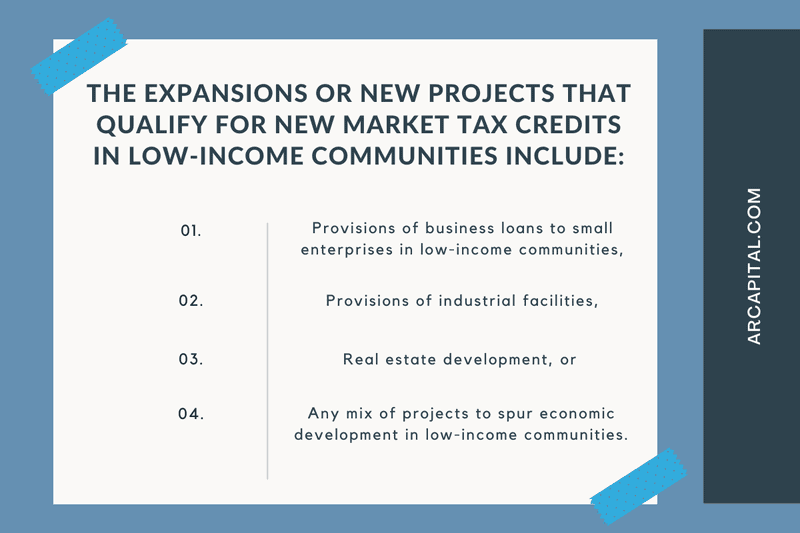
What does it mean to be NMTC Qualified? The projects and businesses that qualify for New Markets Tax Credits must meet any of the following criteria in addition to operating in low-income communities:

  1. The project provides business loans to businesses owned by women and minority communities. These loans provide capital for small and medium businesses to increase development.
  2. The investment must create quality employment for qualifying communities. Most NMTC qualified investors operate in areas whose unemployment rates are one and a half times higher than the national average.
  3. Qualified NMTC investors must also demonstrate their commitment to environmental sustainability. Low-income communities may face poor conditions, such as insufficient clean water. Rehabilitation works are also included in the eligible projects under the environmental sustainability programs.
  4. Providing amenities like healthcare and education services in low-income communities are also eligible for NMTC. Other qualifying projects include affordable housing and real estate developers who offer flexible rent arrangements for tenants.

What Is a New Markets Tax Credit Loan?

Once you know what New Market Tax Credits are, what a New Market Tax Credit Loan means is an easy guess. In addition to what NMTC sends back, the NMTC program also offers loans to encourage business growth in economically distressed areas. A New Markets Tax Credit Loan provides financing for borrowers to buy, build, or renovate space for their business or organization in low-income areas. This is arranged through the CDE of the area.

Research shows that some NMTC-qualified projects would work even without incentives. The apparent low return from investments in low-income communities may turn into an advantage. Investments in poverty-stricken areas sometimes generate returns equal to what might be expected in any location. Subsequently, the tax credit becomes an additional, bonus return for businesses in low-income communities.

Let Us Help You Grow

If you are looking for a CDE to get started with the New Market Tax Credits program, Arkansas Capital Corporation can help. In addition to deploying $200 million in NMTC capital, we have worked with HFR to fund 35+ projects, and create or retain 3,538 jobs. Let us help you today! Contact Arkansas Capital at 800-216-7237 or 501-374-9247.

Filed Under: Article

Why Veterans Make Great Entrepreneurs

नवम्बर 9, 2016 by Isabella

Veteran's DayNovember 11 is Veteran’s Day, but at Arkansas Capital, we’re celebrating the brave men and women who have served our country all week. From our Lunch and Learn for veteran entrepreneurs later this month to our “This One’s On Us” veteran celebration at Flyway Brewing on Friday, we want to take every opportunity we can to honor those who have spent time in the armed forces. [Read more…]

Filed Under: Article Tagged With: veterans

How to Celebrate National Entrepreneurship Month

नवम्बर 2, 2016 by Isabella

National Entrepreneurship MonthNovember is National Entrepreneurship Month, and we at Arkansas Capital couldn’t be more thrilled to celebrate all the outstanding businesses and organizations owned by entrepreneurs throughout the state. [Read more…]

Filed Under: Article Tagged With: Arkansas entrepreneur

Logo with three blue vertical bars on the left and the text "ACC Capital Empowering Entrepreneurs" in white on a light gray background.
Blue and white graphic with a smiley face and the text “Arkansas Business Best Places to Work 2026.”.
Logo featuring the text "CERTIFIED CDFI U.S. Department of the Treasury" with building silhouettes at the top and a circular official seal design.
The image shows the word "AERIS" above the word "RATED" in large, bold, white letters on a light background.

ACC Capital Foundation is the charitable arm of ACC Capital, Inc., a community development financial institution headquartered in Little Rock, Arkansas. ACC Capital Foundation is not affiliated with, sponsored by, or associated with the Atlantic Coast Conference or any of its member institutions. "ACC" as used herein refers exclusively to ACC Capital, Inc.

In accordance with federal law and U.S. Department of the Treasury policy, this institution is prohibited from discriminating based on race, color, national origin, sex, age, or disability. Submit a complaint of discrimination, by mail to U.S. Department of the Treasury, Office of Civil Rights and Equal Employment Opportunity, 1500 Pennsylvania Ave. N.W., Washington, D.C. 20220, (202) 622-1160 (phone), (202) 622-0367 (fax), or email crcomplaints@treasury.gov

© 2026 ACC Capital | Privacy Policy | Cookie Policy | Terms of Service | Disclaimer | Site by Wonderly

Logo with three blue vertical bars on the left and the text "ACC Capital Empowering Entrepreneurs" in white on a light gray background.

Who We Work With

For Borrowers

For Brokers

For Developers

Small Business Lending

Small Business Loans

Our Approach

Bank Partners

Business Development Officers

Quick Links

Careers

Contact Our Team

Blog

FAQs

Honors & Awards

Language Assistance Plan

ACC Capital Foundation is the charitable arm of ACC Capital, Inc., a community development financial institution headquartered in Little Rock, Arkansas. ACC Capital Foundation is not affiliated with, sponsored by, or associated with the Atlantic Coast Conference or any of its member institutions. "ACC" as used herein refers exclusively to ACC Capital, Inc.

In accordance with federal law and U.S. Department of the Treasury policy, this institution is prohibited from discriminating based on race, color, national origin, sex, age, or disability. Submit a complaint of discrimination, by mail to U.S. Department of the Treasury, Office of Civil Rights and Equal Employment Opportunity, 1500 Pennsylvania Ave. N.W., Washington, D.C. 20220, (202) 622-1160 (phone), (202) 622-0367 (fax), or email crcomplaints@treasury.gov

Hindi
English