
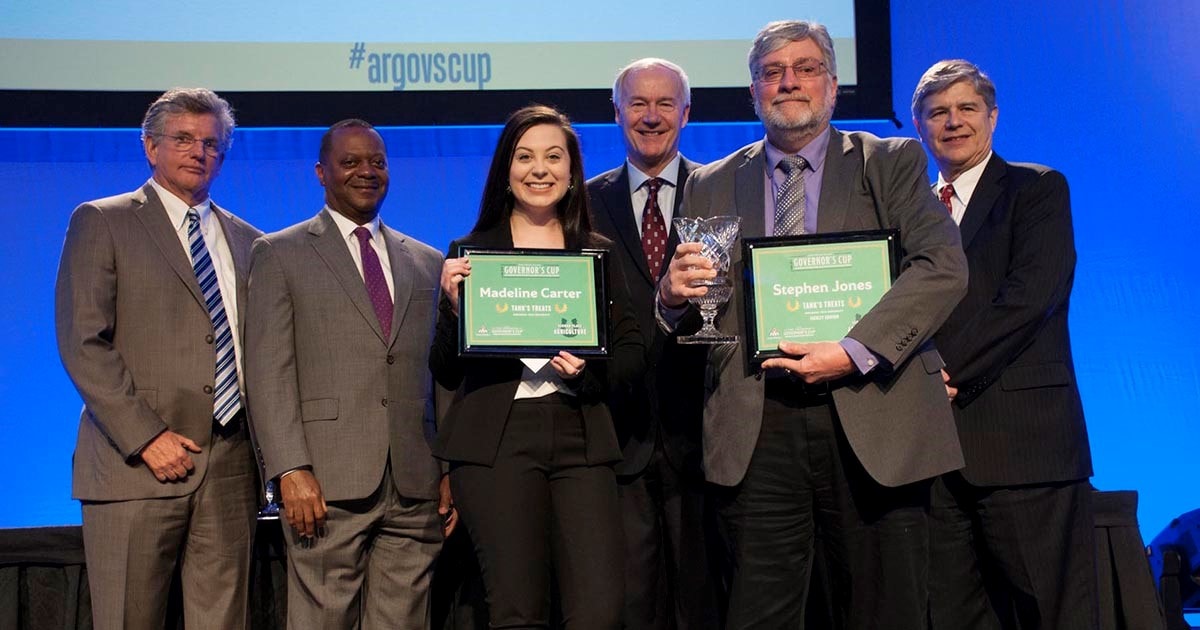
Little Rock-based nonprofit Arkansas Capital Corp. announced Monday (March 7) the 12 finalists for its annual Arkansas Governor’s Cup Collegiate Business Plan Competition.
Little Rock-based nonprofit Arkansas Capital Corp. announced Monday (March 7) the 12 finalists for its annual Arkansas Governor’s Cup Collegiate Business Plan Competition.

Nearly 150 teams made up of 446 students from 26 schools competed in Arkansas Capital’s 17th annual Youth Entrepreneur Showcase (Y.E.S.) for Arkansas 5th-8th Grade Business Plan Competition! See the winners here!!
America and Arkansas were built on the foundation of dreams—the dreams to own a thriving business; to purchase a home you’re proud of; to access quality education; to adequately provide for your family, and to live a vibrant wholesome life.
In many instances, dreams have been extinguished due to a lack of financial accessibility. At Arkansas Capital, one of our main goals is to create accessibility so that our Natural State neighbors can realize their dreams. Community engagement and targeted outreach make this vision for a better life a true possibility.
Community development in Arkansas is essential as it supports improvements in the quality of life for low-and moderate-income individuals and rural communities. In 2020, the United States Census reported that more than 16 percent of Arkansas residents are living in poverty. The per capita reported income in 2019 was just over $26,000. This illustrates the dire need for community support and engagement. At Arkansas Capital, we strive to formulate and offer traditional and creative solutions that will stimulate economic growth through lending products, tax credits, and other funding mechanisms, and entrepreneurial training and development thereby creating stronger communities throughout the state.
Community development advances our communities by increasing homeownership rates, spurring small business development, increasing graduation rates, supporting workforce development, and more. Community development ensures that Arkansas residents have vital living components to live more sustained and healthier lives. Investing in our neighbors allows us to build a foundation, which enables our neighborhoods to attract and keep talent, start and build businesses, and resolve problems that arise.
When community development works, it results in less crime, shrinks wealth gaps, creates more and better jobs, nurtures a more capable and willing workforce, and decreases overall problems that directly impact residents. Some examples of community development include:
By promoting entrepreneurship, supporting small businesses, and striving to make commercial financing accessible, we can increase prosperity in Arkansas. One way we do this is by offering an array of lending products to build Arkansas up.
We offer loans to help our Arkansas neighbors
To service a variety of borrowers, we offer the following types of loans:
To ensure you are best positioned for long-term success, we offer:
In addition to our lending services, Arkansas Capital impacts community development through its Heartland Renaissance Fund (HRF). HRF is a subsidiary of Arkansas Capital and a Community Development Entity (CDE) as certified by the U.S. Department of Treasury.
This CDE designation allows Arkansas Capital to facilitate community development financing and job creation opportunities targeted to low-income communities in Arkansas and surrounding states, most notably through the deployment of New Markets Tax Credits (NMTCs).
Arkansas Capital was the first CDE established in the state when it launched HRF in 2001. Since that time, through multiple rounds of allocations, Arkansas Capital has deployed $355 million of NMTCs into Arkansas and surrounding states.
With a combined $1.1 billion in transaction experience and over 75 years of experience in structuring investment capital, Arkansas Capital’s HRF team can help innovative, early-stage, and high-growth companies in the following areas:
“Our first question is not ‘how can we make money?’ Our first question is ‘where is there a need?’ Over the years, these things you’ve seen us do have been a response to specific needs—no one else is doing it, so we say, ‘Alright. Let’s do it.’’’
Sam Walls, III – President and COO, Arkansas Capital Corporation
We’d like to talk to you more about your ideas – call us, or fill out our online form to let us know how we can help.
Empty warehouses with cracked windows, outdated manufacturing facilities, and desolate commercial spaces: this scene is all too common in many impoverished areas in the United States. Thankfully, two federal tax incentive programs exist that are designed to improve such places by promoting private capital investment in distressed areas across the country. These two programs are the New Market Tax Credit (NMTC) Program and the Qualified Opportunity Zone (OZ) Program.
The goals of the programs are similar, working to improve economic situations in historically low-income areas. However, there are key differences when it comes to comparing the new market tax credit vs. opportunity zone programs. In this article, we’ll discuss the pros and cons of each incentive.
The New Market Tax Credit incentive has generated $8 of private investment for every $1 of federal funding provided. It’s funded over 5,400 businesses and has developed 178 million square feet of manufacturing, office, and retail space. Since its beginnings in 2000, $27 billion in tax credits has been allocated to investors, halting disinvestment in communities that need economic support most. This is to say that there are many benefits happening across the nation as a result of the NMTC Program.
In addition to the obvious positive impact on communities across the nation, investors also benefit by applying the tax credit to their annual federal income taxes. The incentive allows investors a direct tax credit for seven years following an investment within a struggling community that culminates in a total tax credit on the amount invested of 39%. Investors can claim 5% of the specified investment amount every year for the initial three years. Then, they can claim 6% for each of the last four years, adding up to the seven-year 36% total tax credit.
There are a few stipulations for the NMTC, which some investors may see as cons. Many first ask what can new market tax credits can be used for, and one potential con of the NMTC Program is that it can only be applied as a tax credit against the investors’ annual federal tax returns. It can be used in no other way.
Additionally, to qualify for the tax credits, the investment project must be designated as NMTC-eligible within a qualified census tract. The more economically distressed an area, the more likely the Community Development Entity (CDE) is to be approved to receive tax credits. Historically, the CDFI has preferred CDEs to invest in communities where poverty rates exceed 30% and the median incomes of the area are no more than 60% of the statewide median income.
Investors are required to go through a CDE to receive tax credits. All NMTC applicants must be certified as CDEs, then distribute the approved credits to the investors, meaning that a business or investor cannot directly apply for the tax credit.
Lastly, the NMTC is up for renewal yearly. This means Congress could decide to end the program. However, this is not expected in the future, as the incentive has been renewed a number of times since its inception in 2000 and has a proven track record of revitalizing low-income areas. Congress not only voted to continue the incentive in 2021, but they also increased funding for it. For many, the pros of the NMTC Program outweigh the potential cons.
The process of applying for the NMTC may vary depending on qualification and location, however, generally, it only takes five steps:
Note that there are timelines regarding this application, so be sure to see the CDFI website, and reach out to us with any questions (click for state-specific information).
The primary difference between the new market tax credit vs. opportunity zone programs is that Congress must decide annually to renew the NMTC incentive, and it’s approved by the Treasury Department and the CDFI staff. The OZ program is a part of an International Revenue Service (IRS) rule; as such, it doesn’t have to be approved every year. Additionally, Arkansas Opportunity Zones affect capital gains on an investment, as opposed to being applied as a direct tax credit on a federal return (as the NMTC is).
In 2017, the US government developed the OZ Program to promote investments in economically disadvantaged areas. It also gave investors wondering how to invest in opportunity zones an additional avenue for wealth-building. There are 8,700 areas in the US that are designated Opportunity Zones, offering investors a number of communities to support while they generate passive income. Additionally, some Opportunity Zone tax benefits stand right now, including the following:
Opportunity Zones operate differently from the NMTC Program. Investments in low-income communities are inherently risky, which is, in itself, a potential con. However, there are a few other cons to consider when it comes to this government incentive:
If you’re searching for a way to positively impact low-income communities and generate income, these types of investment opportunities could be for you. Both routes can offer incredible returns and tax breaks; however, don’t forgo the research. Fully analyzing the projects and pros and cons of the new market tax credit vs. opportunity zone programs is advisable in order to mitigate risk and make the best decision for you and the community you might impact.
Our subsidiary, Heartland Renaissance Fund, LLC (HRF) is one of the largest Arkansas-focused community development entities, as well as a multi-round recipient of the US Treasury’s New Market Tax Credit Allocation. Since 2003, we’ve received $335 million in federal allocation. We’ve monetized and invested the credits in numerous low-income communities, truly making our state a better place to live and do business.
For more information about our opportunities, contact us today at 800-216-7237, or fill out our online contact form. We look forward to making a difference with you!

At Arkansas Capital, our goal is creating partnerships between Arkansans and the lending community. We have been worked with our subsidiary, Heartland Renaissance Fund, LLC (HRF), to deploy $200 million in New Markets Tax Credit (NMTC) to Arkansas communities. HRF is one of the largest Arkansas-focused community development entities (CDEs) and a multi-round recipient of the U.S. Treasury’s New Market Tax Credit Allocation.
Now, you may be asking “what are New Market Tax Credits?” Keep reading to answer that question and find out about the important New Market Tax Credits program offered by Arkansas Capital through HRF.
New Markets Tax Credits (NMTC) are a federal tax incentive aimed at spreading investment and economic development to low-income areas in the United States. Since its inception in 2000, NMTC has facilitated the establishment of 4,800 projects spread across all 50 states.
The incentive program works by allowing a 39% tax credit to qualified investors. This increases value by reducing tax expenses. Despite the benefits accrued by a new investment or company, not many investors understand the incentive tax program.
Here, we will explain:
Tax Credit Investment is a means of making an investment that helps socially, environmentally, or even governmentally. The government uses tax credits to encourage growth in necessary areas of the economy. A Tax Credit Investment almost guarantees a return on your investment by getting a higher tax return or paying less taxes during tax season.
Depending on the specific tax credit program, Tax Credit Investments can be great ways to invest in socially conscious ways. New Markets Tax Credits, for example, encourage growth in low-income areas. Others might prompt green energy resources or improve diversity.
A tax credit is the sum of money an investor or taxpayer is allowed to deduct from payable taxes. As a taxpayer, you already know taxes reduce your net income because they are an essential payment when you make money. A tax credit increases your net income by reducing your liability to the state.
Most taxpayers consider a tax credit to be a good thing. While both credits and deductions make what you owe in taxes decrease, they do so in very different ways. Tax credits in particular reduce the amount of taxes you owe dollar by dollar. You may pay less back in taxes, or you might get a higher refund.
What is the downside of receiving a tax refund like this? Because the New Market Tax Credits are specifically intended for low-income communities, these projects or businesses may not be as successful as they would be in more industrialized or higher-income areas. While you do receive the tax credit, the program can have this downside for investors.
The other downside of receiving a tax refund through what is called Tax Credit Investments is that there can be a lot of hoops to jump through. Certain requirements must be met and the types of programs or businesses may be limited by the rules of the tax credit in question.
New Markets Tax Credits are a specific tax credit applicable only to projects or businesses investing in low-income areas. The tax credit works as an incentive for investors to initiate projects in New Market Tax Credit qualified areas.
NMTC offers a 39% tax credit to new investors over 7 years. The tax credits are split into two phases: a tax credit of 5% of your initial investment for the first three years and 6% for the remaining four years. However, the tax credits are only achieved through Community Development Entities (CDEs).
Who are Community Development Entities (CDEs)? CDEs are investment units that serve low-income communities. The advisory board of a qualifying CDE must be composed by at least 20% of local community members. NMTC are awarded to CDEs, who then attract investors to provide equity and receive tax credits in return.
New Markets Tax Credit are intended to encourage investments and development in all the forgotten corners of the United States, particularly those suffering from widespread poverty or low-income status. The program works under the assumption that investors may shy away from investing in areas considered less productive.
As an investor, the location of your business is a key area of concern. To compensate for the expectation of perceived low returns, the government allows you to deduct 39% of income tax from the total tax payable over 7 years. The tax credit reimburses the income you might have earned in a more favorable location. Using the New Market Tax Credit investment makes seemingly poor business locations more viable, attracting investors.
An NMTC qualified investor intends to start or expand a business into designated low-income communities by working with CDEs. Low-income communities are census tracts with a poverty level of at least 20%, family incomes 80% less than the area median, or a non-metropolitan census tract exhibiting certain signs of distress based on Census data.
Eligibility for the New Markets Tax Credits is also qualifying a business as Qualified Active Low Income Community Businesses (QALICBs). Investors through the New Market Tax Credit must meet certain conditions.
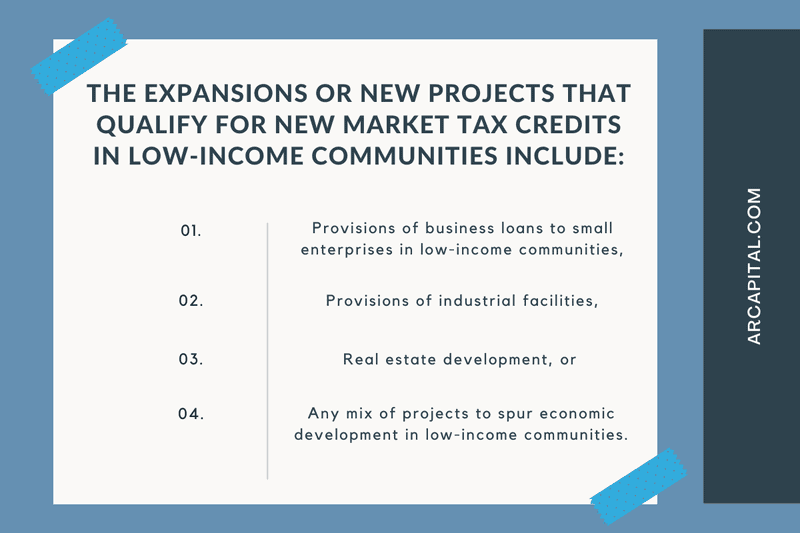
What does it mean to be NMTC Qualified? The projects and businesses that qualify for New Markets Tax Credits must meet any of the following criteria in addition to operating in low-income communities:
Once you know what New Market Tax Credits are, what a New Market Tax Credit Loan means is an easy guess. In addition to what NMTC sends back, the NMTC program also offers loans to encourage business growth in economically distressed areas. A New Markets Tax Credit Loan provides financing for borrowers to buy, build, or renovate space for their business or organization in low-income areas. This is arranged through the CDE of the area.
Research shows that some NMTC-qualified projects would work even without incentives. The apparent low return from investments in low-income communities may turn into an advantage. Investments in poverty-stricken areas sometimes generate returns equal to what might be expected in any location. Subsequently, the tax credit becomes an additional, bonus return for businesses in low-income communities.
If you are looking for a CDE to get started with the New Market Tax Credits program, Arkansas Capital Corporation can help. In addition to deploying $200 million in NMTC capital, we have worked with HFR to fund 35+ projects, and create or retain 3,538 jobs. Let us help you today! Contact Arkansas Capital at 800-216-7237 or 501-374-9247.

The U.S. Department of Treasury’s Community Development Financial Institutions Fund (CDFI) announced this week that Arkansas Capital Corporation, a CDFI Community Development Entity, is one of 73 applicants selected nationwide to share a total of $3.5 billion in New Markets Tax Credits (NMTCs) for providing financing to low-income communities resulting in economic impacts, job creation, and other community benefits to these distressed areas.
Arkansas Capital Corporation is the only CDE in Arkansas to be awarded NMTCs in this round of allocations. It is the sixth award of allocations for Arkansas Capital Corporation since NMTCs were first awarded in 2003. The announcement brings to $300 million the total amount of NMTCs awarded to Arkansas Capital Corporation to grow business and economic investments into distressed communities in Arkansas and bordering states.
“Through the $265 million in NMTC allocations we’ve received in the previous five rounds, Arkansas Capital Corporation and our partners have produced 1,777 direct jobs and 924 construction jobs in the most distressed census tracts in our state,” said Sam Walls, president of Arkansas Capital Corporation. “These jobs are part of more than 30 projects deployed so far. With our local and state partners, we’ve been able to finance rural manufacturing operations, nonprofit, and educational facilities; and rehabilitated historic buildings in abandoned Main Street corridors,” he said.
Walls continued, “Arkansas Capital Corporation is always looking for impactful projects in Arkansas, especially in low-income areas, where local officials are struggling to find capital for projects to grow their economies, provide jobs, and overall increase the well-being of their communities. The NMTC program is a perfect opportunity to use tax credits to drive investments into the most underserved census tracts.”
Walls says successful deployment of NMTCs is not possible without local and state partners from both the public and private sectors. “Partnerships are key. We must rely on local officials to give us guidance on what projects are needed in their communities that have the most impact and be the best for the long term.”
Walls expects the new round of NMTCs will be deployed by this fall.
Arkansas Capital Corporation and its companies have worked since 1957 to offer flexible capital solutions to meet the unique needs of entrepreneurs, small businesses and other commercial projects underserved by traditional lenders. The NMTC program is an example of Arkansas Capital Corporation’s unique ability to work with the public and private sector to structure innovative financial products that promote catalytic economic development for Arkansas. Since 2010, through more than 200 transactions, Arkansas Capital Corporation has invested $443 million into Arkansas with the following outcomes:
“New Markets Tax Credits are a phenomenal program,” said Walls. “We are proud to have been able to bring them to the state.”
To read the U.S. Treasury’s New Markets Tax Credits Award Report, click here.
According to recent studies, roughly 550,000 Americans each month quit their jobs in pursuit of entrepreneurship. And why not? With dreams of flexible schedules, working from home and an income boost, entrepreneurship sounds pretty nice! And it is. But that’s not to say that financial freedom occurs overnight. It takes a plan to make that plunge successfully, and we’ve got your first few steps here.
Making the move from salaried employee to small business owner is not a decision that should be taken lightly. So before you quit your day job, think about what’s motivating your future business venture. Are you eager to start because you have a passion that could be the answers to peoples’ problems? Or, do you hate the monotony of a 9-5? If you related more to the latter, entrepreneurship may not be the right route for you.
No parent would ever hand a child a baseball glove and a pack of sunflower seeds, and push him in the direction of a ball field if he had no prior knowledge as to what the game is. How would he know what to do? What’s the point of the game? The idea is similar in business. If you don’t have both long and short-term business goals set, you and your employees will never know what’s being worked toward or if progress is being made. Luckily, this usually comes in the form of a business plan.
Whether you prefer, “There’s no ‘I’ in ‘team’,” “It takes two to tango,” or, “Two are better than one;” there’s no shortage of clichés to drive home this point– venturing out on your own doesn’t mean that you have to be on your own. Foster your network of experts and potential customers to continue to grow your business, then start expanding that inner circle. From industry events to community organizations, there are never too many people in an entrepreneur’s network.
Generally, experts everywhere agree that the number one reason new businesses fail is quite simple– they run out of money. Using your business plan established in step 2, combined with your growing network we discussed in step 3, determine the amount of startup capital you need to get on your feet. Then, the rest is simple– contact Arkansas Capital! With low down payments and over 6 decades of experience, we have several different types of loan products to fit your needs.
Now that you have a plan and you’ve secured financing, pull out your calendar because it’s time to set a resignation date! Though it may not be time to pack up your office just yet, having a plan in mind should help you be able to determine what is and is not feasible. And with Arkansas Capital on your side, you’ll have the lending expertise and support you need to promote yourself from employee to entrepreneur.
Whether you forgot to attach an important document on an email, you lost a client, or you allowed private user data to be shared with third parties (we’re looking at you, Zuckerberg); mistakes are inevitable. Sure, you may feel embarrassed or even ashamed, but with these insider secrets, you can turn your business kink into customer loyalty.
Unless you’re a pilot, surgeon or President of the United States; any mistake that you make at work can likely be quickly corrected. So don’t sweat it! Take a deep breath, count to ten and keep things in perspective by not responding in a way that’s bigger than your blunder. As Psychology Today writer, Dr. Suzanne Gelb, puts it, “On the freeway of life, [your mistake] is a parking ticket, not a multiple car pile-up.”
In work and in life, the true test of character comes out in chaos. After all, how you respond to messes and mistakes could convert a potential business loss into a loyalist. But first, you have to own up to it. Being as swift and concise as possible, start with supervisors and any parties involved, and explain your mistake honestly and thoroughly. Recognize where you went wrong, and explain how you’ll recover from the situation. Your boldness will show your team the importance of remedying problems.
Take a walk in your customer’s shoes, and consider what would exceed your expectations if roles were reversed. Yes, you should absolutely apologize, but then follow it up with a “wow” factor. Your customers should leave the experience feeling more than satisfied– they should be excited.
It’s a cliché because it rings true. The best way to earn back people’s trust and admiration is to be consistent at delivering great work. Take necessary precautions to avoid your past mistakes, and in the meantime, do your very best. With a strong work ethic, any occasional “oops”-inducing issues will be quickly forgiven and forgotten.
The truth is, there’s nothing you can do to stop problems from popping up. Your response though? That’s in your control. And if you ever have any questions, don’t be afraid to call on professional help. Our staff at Arkansas Capital has provided lending expertise and support to Arkansas businesses for over six decades, so no matter what your inquiry is, we have the information to help.
If you invited the world’s most successful CEOs to dinner, you would find yourself sitting at the table with a diverse group of people with different personalities, backgrounds and approaches to running their businesses. By the time dessert was being served, you would fully recognize that extraordinary business success comes in all shapes and sizes, and our uniqueness as people directs us to a certain type of leadership style. No one style is necessarily better than the other. But by identifying and better understanding your style, you can become a stronger and more successful leader. That’s where we come in. Read through our top six leadership styles to discover where your strengths lie, and what you can improve upon.
Transformational leaders, in the most simple terms, are innovators. They’re managers that recognize the need to continually try new ideas, and they plan to be that role model of transformation for their entire team. Constantly challenging the status quo to find ways to “be better,” these highly motivational leaders have an eye for spotting what is and isn’t working, but can also be intimidating to those who aren’t as excited about change.
You’ll recognize pace setters as the Bill Gates and Elon Musks of the world. They set sprinting paces from the very beginning, and both their company and their industries follow. Although these high-energy visionaries pride themselves on staying at least two steps ahead of competitors and motivating their subordinates to do the same, pace setters’ employees often report a higher “burn out” rate.
Joining the ranks of Oprah and Barack Obama, charismatic leaders ooze charm, and are often those that people naturally gravitate towards. Because of their charisma, these encouraging leaders naturally inspire employees and build long-lasting business relationships. Although they may be prone to miss some finer details of projects, they’re at their best when working with a team.
This “hands-off” attitude of leadership is a risky one, but one that has worked well for multibillionaires Warren Buffet and Richard Branson. Laissez-Faire leaders take on more of a mentoring role, delegating work objectives and decision-making to employees, but providing general direction and guidance when requested. This style of leadership is ideal for creative industries or an office of self-motivators, but if accountability isn’t set early on, productivity can quickly diminish.
Contrary to the Laissez-Faire leaders, those who fall in this category tend to take a “hands on” approach to leadership, focusing on identifying and developing strengths their employees possess. Coaching leaders naturally create well-trained successors and a strong bond with employees, but have to carefully toe the line between “teaching” and “micromanaging.”
These visionary leaders set clear standards and goals, and then step back to allow their teams to reach them. Providing fair and constructive feedback as needed, authoritative leaders thrive in high-stress situations and are known for inspiring enthusiastic and confident teams, but can also result in fearful or underdeveloped employees.
Arkansas Capital has provided lending expertise and support to local businesses for over 60 years, so no matter your leadership style (or combination of styles), we’re here to help! We offer the funding services and industry expertise your business needs to help launch or grow.
Whether you hate them, love them or love to hate them; one fact is true– clichés wouldn’t have become cliché if they didn’t resonate. Sure, you still need to “think outside of the box,” but not all clichés are eye-roll-worthy. Take a look at our top favorite ones that we think should be reintroduced to the workplace… and those that should never be used again.
Entrepreneurs tend to prefer to do things on their own (they wouldn’t have opened their own business if they didn’t), but it’s important to remember this straight-forward saying. Running a business takes a lot of moving parts, and if business owners want to be successful and maintain their sanity, hiring a team made up of passionate employees is imperative.
Of course, the customer is not always “right,” but in reality, that’s not the important takeaway with this popular phrase. Instead, use this general concept to face any business issues that arise. Every problem that a customer presents is a chance for your company to address it, make the customer happier and let them feel “righted.”
This cliché is the pessimistic cousin to the “There’s no ‘I’ in team,” phrase, and it’s the root of what causes many entrepreneurs to break or make poor business decisions. Instead of taking on every business task yourself, learn to delegate early on to promote better mental health.
Sure, there are things you should ignore in your business (we’re looking at you, gossipers), but in order to scale, you have to know what is and isn’t working for your company. Don’t be blissfully unaware of advice that could benefit your business, how your clients feel or how your company is performing. In short, we combat this cliché with one that we think is more accurate– “Knowledge is power.”
No matter what niceties you choose to listen to, ignore or create for yourself, every business needs assistance. That’s why Arkansas Capital has provided our financing products and expertise to local businesses for over 60 years. If you’re looking to start a business or grow your existing one, contact us today.
Here at Arkansas Capital, our main goal is to empower local entrepreneurs– those of every age. That’s why, in 2001, the idea of the Arkansas Governor’s Cup was formed.
This prestigious, statewide competition challenges college and universities’ best and brightest entrepreneurs to develop and present business plans. The reward? A real-world, rigorous startup experience and an opportunity to win part of the country’s largest cash prize pools for collegiate business plan competitions!
On April 18, with over 500 people in attendance, our awards luncheon was held at the Statehouse Convention Center. Representing more than 30 teams from Arkansas Tech University, Arkansas State University, Arkansas School for Math, Sciences & the Arts; Harding University, Henderson State University, Hendrix College, John Brown University, Ouachita Baptist University, University of Arkansas, University of Arkansas at Little Rock, University of Arkansas at Pine Bluff and University of Central Arkansas; the winners took away a cumulative $154,000 in cash prize awards provided by title sponsor, Delta Plastics.
The 2018 Governor’s Cup Award Recipients are:

First Place: Spiritum Solutions, University of Arkansas at Little Rock– $25,000
Second Place: winterterm.com, Ouachita Baptist University– $15,000
Third Place: Monity, Harding University– $10,000

First Place: Lapovations, University of Arkansas – $25,000
Second Place: UChooze Lunchbox, LLC, University of Arkansas– $15,000
Third Place: Ozark Microheater Systems, University of Arkansas– $10,000

First Place: Connor Innovation Roveround, University of Arkansas– $5,000
Second Place: SCAN AG, University of Arkansas– $3,000

TiFix, Harding University– $5,000

Ozark Microheater Systems, University of Arkansas– $5,000

Spiritum Solutions, University of Arkansas at Little Rock– $2,000

Lapovations, University of Arkansas– $2,000

Dr. Chris Brune, Ouachita Baptist University– $2,500
Dr. Kenneth Olree, Harding University– $2,500
The pursuit of profit isn’t a new one, and from Marco Polo to Mark Zuckerberg, the world has seen many different faces attempt this venture. One common characteristic, though? Entrepreneurship. Take a look at what it looked like seven centuries ago, and how it has evolved since.
Global business? That’s not a 21st century discovery. In fact, we have the early Renaissance entrepreneurs to thank for that. Craftsmen in the 1300s spent several years working as apprentices to learn their trade, make more money and therefore hold more power in civic affairs. When product demand eventually grew to be more than the average tradesman could provide, trade expanded into other countries, and the “adventure-preneur” was born.
Thanks to ship-building advancement, the first global company, the Dutch East India Company, got its start during this time period. With international travel now booming, merchants began readjusting their selling tactics by strategically setting up trading posts along trade routes to sell supplies to shipping crews. Because colonies didn’t rapidly show profit in these tactics, many English investors withdrew their capital, leaving the market less-competitive– and entrepreneurs more independent than ever (Cue the United States’ independence).
The next evolutionary stage of entrepreneurship introduces the great innovators many of us so commonly know. Inventors such as Benjamin Franklin and Eli Whitney thrived during this era, but they weren’t the only ones in the market. Business owners could taste what success was like, and began rapidly working on inventions to increase productivity, scale manufacturing and reduce costs. And with wind-powered energy a hindrance of the past, they did just that. In fact, we can thank the inventors of this time period for the technology, transportation and communication that we have today.
With global trade, electricity and communication now at most entrepreneurs’ fingertips, business in the 20th century was on the rise, with no end in sight. With mass communication now a viable option for marketing a business, 20th century business owners took advantage of it. Advertising spending went up to 45% of the United States’ income, and by 1910, $600 million was being invested into advertising for big businesses alone. For the first time ever, entrepreneurs had newspapers, television and radio as platforms to share their products with the world.
Welcome to the Information Age! Gone are the days when computers fill an entire room. Personal computers are now the norm, and global marketplaces can be accessed with the click of a button. Geographic borders, that were once limitations, have been blurred, and most entrepreneurs can boast a “.com” at the end of their business name. Modern day business owners no longer just spend their time innovating new products and services, but instead, they manage employees and run new companies.
We may not be able to predict what entrepreneurship will look like in the future, or whose face will represent the next era, but we know one thing will remain the same– our team at Arkansas Capital will be here supporting entrepreneurs and growing local businesses in our state. Since 1957, our team has provided flexible financing products of over $1.5 billion in capital to help meet business owners’ needs. Contact us today to find out how you can be a part of history.